
Unlike many other countries, there are hundreds of different types of Persian rugs, from all across the country. We thought it may be helpful to form a brief encyclopedia for you guys to refer to if you feel a bit lost at sea! I must say that there are many that will not be on this list, as, for example, within the Hamadan region there are over 134 villages itself! So to avoid being too overwhelming I've grouped together and simplified as much as possible. As ever, if you have any questions or would like to do about a Persian rug that is not on the list, please do reach out to us and we would be more than happy to help.
Types of persian rugs generally come in three categories: city, village and tribal. They are all named after the city or village they were made in, or by the tribes that made them. The city rugs are known to be the highest in quality. The city rug weavers in Iran are known as 'master weavers' and some of them even sign their work, like a piece of art.
Simply put, the city weavers are mostly men and this is their full time career and income. Those that are made in villages, or by tribes, on the other hand, are made by families. They weave the rugs, often from memory or inspiration on their travels, and sell them as an extra source of income.
Have a look through and get to know which designs you like best.
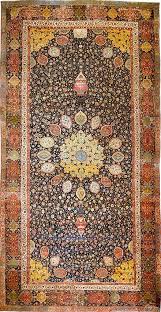
Tabriz Rug Design
Tabriz rugs originate from Tabriz, capital city of Azerbaijan and one of the oldest rug weaving centers in the region.
The patterns range from teardrop medallions to floral, trees and hunting scenes. Antique Tabriz rugs are extremely valuable and can only be found in exclusive private collections and museums. The most famous Tabriz design is known as 'Tabriz Mahi'. The design is based on a famous Persian garden that is divided into four sections by a stream. In the stream are many fish. The word 'Mahi' in
Heriz Rug Design
Bright vibrant colors and characteristic bold patterns make these rugs easy to identify. Heriz rugs will always feature an oversized medallion in the center, with a double or triple outline and large corner pieces. These rugs are very durable and will last for generations.
Kashan Rug Design
The medallion and corner pattern on an ornately patterned floral field is a trademark of Kashan rugs. The colors used in the designing is usually a combination of deep blues, rich reds and ivory with occasional splotches of yellow, green and burnt orange. These rugs are high quality with a knot count that ranges from 100kpsi to over 800 kpsi.
Gabbeh Rug Design
Woven by Qashqai and Luri weavers in the Zagros Mountains, the tribal influence is very evident in Gabbeh rugs. Made of local handspun wool, these rugs are thick and coarse and the designs are simple and woven on a plain lush field of color. Only natural dyes are used and typical colors of these rugs are orange, yellow, rust or red.
Isfahan Rug Design
The design of silk and wool design Isfahan rugs is very balanced and symmetrical. Typically it will consist of a single indigo, rose or blue medallion surrounded by vines and woven on an ivory background.
Nain Rug Design
Nain rugs are high quality with very fine quality wool and a knot count of about 300 kpsi to 700 kpsi. The patterns are very intricate and usually consist of blue or green intertwined branches with tiny flowers woven on a white or light ivory background.
Sarouk Rug Design
Sarouk Carpets are of a fine compact weave, with mellow colors, often featuring medallion designs. Compatible with traditional or contemporary decor, a Sarouk Rug complements a wide array of rooms, (both large and small), are known for striking color, durability and charm.
Mashad Rug Design
Mashad rugs (also spelled: Mashhad or Meshad) typically feature a lone, oversized Shah Abbasi medallion in the center on an elaborate background filled with floral motifs in a curvilinear design. These rugs are usually large with a wool pile and a cotton foundation.
Balouchi Rug Design
Because of Balouchi rug’s nomadic tribal original, you’ll rarely find a large sized Balouch rug. These small rugs have simple geometric patterns and are woven with sheep wool that is dyed blue or dark red. The edges use camel or goat hair in beige or brown.
Qum Rug Design
Also known as Koum, Kom, Kumm, Qhum, or Ghom, these rugs are woven in the Qum province of Iran. Qum rugs are very high quality.
They are tightly knotted, with a luxurious pile of silk or cotton and intricate designs that include a combination of flowers, birds, medallions, hunting scenes and gardens in dark blue, reddish brown or orange.
Turquoise is always used in some element in a Qum rug.
Hamandan Rug Design
The Hamadan rug is one of the oldest Persian Carpet types to date. The term “Hamadan rug” doesn’t just refer to their birthplace. It’s a collective name for all rugs woven in that region, which is home to more than a thousand different villages, all producing unique and separate Hamadan rug varieties.
Antique Hamadan rugs traditionally feature central medallions surrounded by smaller motifs and patterns. These secondary motifs usually include arabesques, diamonds, palmettes, and other geometrical shapes. The general color palette contains varying hues of red, navy blue, and ivory with black and other pops of colour, depending on which tribe the rugs were originally woven by.
Zanjan Rug Design
Zanjan rugs are another favorite of rug collectors around the world. These Persian pieces, named after their ancient city of origin, are prized for their vibrant color palettes and unique tribal designs.
Zanjan rug designs vary from tribe to tribe, but many feature central medallions with a smaller medallion in the center. The medallions and background are adorned with geometric designs of star motifs, flower heads, birds, animals, and fish or paisley patterns.
For the color palette, Zanjan weavers used the region’s typical reds and dark blues plus lighter hues like ivory.
Malayar Rug Design
Hailing from Malayer, which is in western Iran, the semi-nomadic weavers of Malayer rugs are fiercely faithful to their ancient techniques and shun modern methods. Malayer rugs are single wefted and tightly woven using the symmetric Turkish knot. The subject matter of Malayer rugs is decidedly traditional. Motifs like the Tree of Life, Herati (fish), and medallion motifs with paisley designs are quite popular. They also incorporate symbols like palmettes, flowers, and vines. Because the region is fondly called “the land of grapes”, grapevines, grapes, and tendrils are a common image, too.
Herati Rug Design
This pattern has its name from the city of Herat in Northwestern Afghanistan. It is a common pattern found mainly on handmade carpets from Iran. It comprises of a flower inside a rhomb surrounded by four acanthus-leaves. These leafs are sometimes called fishes, because of its similarity, and the pattern is often used on carpets with an all- over/repeated motif.
Bidgar Rug Design
Antique Bidjar Rugs Bidjar is a town in Persian Kurdistan located in north- west Persia. The Bidjar name is also used to describe the antique rugs that were produced in the many villages in the surrounding vicinity. The Bidjar is noted as being the stiffest carpet made; they are very heavy in relation to their size, and very thick and durable. All of the knots are symmetrical and the rows are beaten down during the weaving process producing a dense compact fabric. Given their thickness and construction Bidjar rugs can be difficult to fold. The many designs depict the Kurdish influence of the area and often floral and classical geometric motifs are employed as well as the use of large, whimsical medallion designs. The color palate is rich and jewel toned making the Bidjar a highly desirable rug sought after by designers.
Gumbad Rug Design
The design patterns of Gumbad designs are inspired by DOMEs of various mosques and monuments. When one looks the dome of a mosque from juts below it, one sees beautiful symmetrical patterns, which were very beautifully captured by the master artisans of Persia.
Kerman Rug Design
Kerman is an ancient city, with an incredible history going back over a thousand years. The city is located in the central south-eastern section of Iran, in the province that bears its name. Kerman rugs and carpets are perhaps one of the most recognizable within the antique Persian rug category. A typical pattern for Kerman rugs and carpets is a floral or architectural theme in the main border with a central medallion in the field. Other patterns include the finer Kerman Lavar style with garden, tree-of-life, vase, and all-over mille fleur designs, or the many pictorials which tell the story of a significant figure or event in history. The vase design carpets originated during the Safavid dynasty, and are among the greatest masterpieces of Persian weaving.
Bakhtiary Rug Design
Bakhtiary Rug Antique Bakhtiari rugs were woven in Zagros Mountains of Iran, and mainly woven by villagers and nomads of the area. The pattern of Bakhtiari rugs is mainly geometric, sometimes semi-geometric, and seldom curvilinear. The designs tend to be very dense, and vibrant colors, such as deep reds, bright blues, navy, greens, brown and beige were commonly used. The most common Bakhtiari design is the garden design, which consists of square, rectangular, diamond, or hexagon compartments filled with floral motives, such as a willow tree, a cypress tree, a grapevine, a vase, or a bird sitting on a branch. Each compartment has a different color and motive from its neighbouring compartments.
Heriz Rug Design
Originated in Northwest Iran, not too far from the city of Tabriz. Heriz design is fairly recognisable. More so than other Persian rug designs. The centre features a large right-angled medallion, and usually has marked corners. They are really geometric in design. The history behind Serapi rugs is interesting. Sometime in the 1930’s, there was a high demand for a type of Heriz rug that was discontinued. In order to capitalize on this high demand and not lose out on potential sales, rug buyers created the Serapi pseudonym to describe that particular type of Heriz rug. That name stuck on and is still being used to describe a high-quality rug that is woven in the district in the village of Serab, located in the Heriz region of Iran. In short, a Serapi rug is a distinctive type of Heriz rug.
Shiraz Rug Design
Shiraz is a type of Persian rug made in the villages around the city of Shiraz, in the Iranian province of Fars. Designs tend to come from settled tribal weavers so they mimic Qashqai, Khamseh (Basseri and Khamseh Arabs), Afshar, Abadeh and Luri designs. The designs are very simple and favored by many people who don’t like the more detailed and busy rugs. They are never too overwhelming in their designs or color schemes. Along with geometric motifs, small animals or plants are often seen in parts of these rugs.
Zeigler Mahal Rug Design
Sultanabad and Mahal rugs are produced in the area around the city of Arak, which has a history of rug weaving dating back to the mid-17th Century. The city was originally founded in 1808 as Sultanabad and later in 1930 was renamed to the city of Arak. The city is older than these dates might indicate. The term Sultanabad has come to distinguish the oldest and highest quality Mahal carpets, also known as Ziegler Mahals, named after a British firm in Manchester, founded in1883, that supervised the production for exports to the West. Most Sultanabad and Mahal rugs have bold and floral designs, whether they utilize classical medallion or overall designs of vine scrolls and palmettes. Traditionally, dark reds and blues were common colors with highlights of soft green and ivory.
Senneh Mahal Rug Design
Originated in the western part of Iran – the province of Kurdistan. Today the capital city is called Sanandaj, but it used to be known as Senneh. Senner design compromises of fine designs and elegant patterns. The colours are usually dark blue and reds. In Senneh they weave both rugs with a pile, as well as Senneh Kilims(flatweaves). Their design is
Qashqai Ghashghai Tribal Rug Design
Qashqai nomads are from the Fars province in the southwest of Iran. They move around once or twice a year – in the winter near the Persian Gulf and in the summer up in the Zagros mountains (as it 's cooler). Qashqai rugs are deeper in colours, using reds, browns, burgundy as the base colour. The pattern is weaved completely from memory and from things that have inspired the nomads on their travels, such as wildlife and nature. You' ll see a lot of four legged animals, birds and trees on Qashqai rugs. Often they are made 100% of wool, making them easier to roll up and transport around with the nomads. Though sometimes they contain cotton.